Skip Link Coverage Across Seven Sectors
Overview
Skip links solve a precise navigation problem: repeated page chrome can force keyboard and assistive-technology users through header links, menus, banners, and other repeated blocks before reaching the page’s primary content. Digitarise measured whether homepages expose an explicit bypass link in server-delivered HTML. The measurement used one HTTPS GET per homepage with no JavaScript executed, so it describes the initial document contract rather than hydrated client behavior. The observed rows were: B2B SaaS (n=33 of 35 sampled, 6% refused an automated request, measured 2026-07-29): median server response 351 ms; median HTML 571 KB; skip link present on 45%; main landmark on 88%; median alt-text coverage 65%; median trackers 2; median third-party domains 12; consent mechanism on 67%. AI platforms (n=33 of 35 sampled, 6% refused an automated request, measured 2026-07-29): median server response 282 ms; median HTML 395 KB; skip link present on 18%; main landmark on 82%; median alt-text coverage 79%; median trackers 1; median third-party domains 10; consent mechanism on 36%. Developer tools (n=33 of 35 sampled, 6% refused an automated request, measured 2026-07-29): median server response 255 ms; median HTML 408 KB; skip link present on 30%; main landmark on 85%; median alt-text coverage 78%; median trackers 1; median third-party domains 10; consent mechanism on 48%.
The remaining measured rows show why the analysis cannot be reduced to a single maturity ladder. Fintech (n=28 of 35 sampled, 20% refused an automated request, measured 2026-07-29): median server response 294 ms; median HTML 545 KB; skip link present on 21%; main landmark on 82%; median alt-text coverage 75%; median trackers 1; median third-party domains 10; consent mechanism on 43%. Healthcare (n=29 of 35 sampled, 17% refused an automated request, measured 2026-07-28): median server response 348 ms; median HTML 153 KB; skip link present on 62%; main landmark on 69%; median alt-text coverage 89%; median trackers 0; median third-party domains 11; consent mechanism on 24%. DTC ecommerce (n=20 of 38 sampled, 47% refused an automated request, measured 2026-07-28): median server response 196 ms; median HTML 846 KB; skip link present on 55%; main landmark on 90%; median alt-text coverage 64%; median trackers 2; median third-party domains 16; consent mechanism on 65%. Retail chains (n=17 of 35 sampled, 51% refused an automated request, measured 2026-07-29): median server response 297 ms; median HTML 833 KB; skip link present on 41%; main landmark on 71%; median alt-text coverage 93%; median trackers 1; median third-party domains 11; consent mechanism on 59%. Because DTC ecommerce had n=20 of 38 sampled with 47% refused an automated request and retail chains had n=17 of 35 sampled with 51% refused an automated request, those two rows are not representative of their sectors; they are only the subset that answered the automated request.
How it works
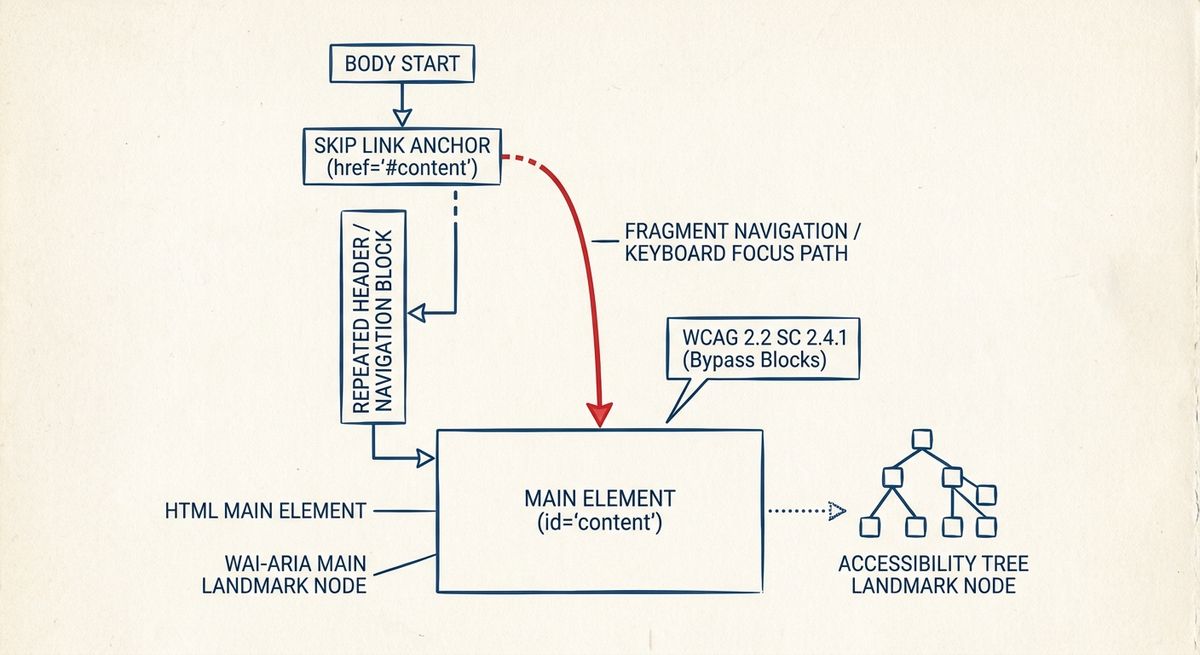
At the systems level, skip link coverage is a property of the first HTML document, not a visual ornament. A typical implementation places an anchor near the start of the body, before repeated navigation, with an href that targets the principal content container. When a keyboard user tabs into the document, that anchor becomes the first or one of the first focusable controls. Activating it causes fragment navigation to the referenced element. If the destination is a main element with a stable id, browsers can scroll the viewport to it, expose the destination through the accessibility tree, and allow subsequent reading or focus navigation to continue from the primary content region. This is why server-rendered availability matters: a bypass mechanism injected only after client execution is absent from a no-JavaScript initial document.
The cross-sector ordering computed from the same rows is: Skip link coverage %: Healthcare 62, DTC ecommerce 55, B2B SaaS 45, Retail chains 41, Developer tools 30, Fintech 21, AI platforms 18 (best first). Those values come from Healthcare (n=29 of 35 sampled), DTC ecommerce (n=20 of 38 sampled), B2B SaaS (n=33 of 35 sampled), Retail chains (n=17 of 35 sampled), Developer tools (n=33 of 35 sampled), Fintech (n=28 of 35 sampled), and AI platforms (n=33 of 35 sampled). The difference between skip link presence and main landmark presence is technically important. AI platforms, for example, had skip link present on 18% and main landmark on 82% in n=33 of 35 sampled; the landmark can help rotor or landmark navigation in assistive technology, but it is not the same as a keyboard-visible bypass control at the top of the tab sequence.
What the standard says
The current stable W3C accessibility recommendation is Web Content Accessibility Guidelines 2.2, published as a W3C Recommendation. WCAG 2.2 extends WCAG 2.1; WCAG 3.0 remains a draft and is not a replacement for conformance claims. The directly relevant requirement is WCAG 2.2 Success Criterion 2.4.1, Bypass Blocks, at Level A: a mechanism is available to bypass blocks of content that are repeated on multiple web pages. The criterion does not require the mechanism to be a skip link specifically. It can be satisfied by appropriate headings, landmarks, or other navigation mechanisms when they actually let users bypass repeated blocks. Digitarise’s skip link metric is therefore narrower than the conformance criterion: it detects one explicit, testable mechanism in the delivered HTML.
The HTML Living Standard defines the main element as representing the dominant contents of the body, excluding content repeated across documents such as navigation links, site logos, and banners. The same specification requires that a document must not have more than one main element that does not have the hidden attribute. WAI-ARIA 1.2 defines the main landmark role, and the HTML Accessibility API Mappings map the main element to the platform accessibility role used by assistive technologies. Related WCAG 2.2 criteria constrain the implementation: Success Criterion 2.4.3, Focus Order, requires a meaningful sequence; Success Criterion 2.4.7, Focus Visible, requires visible keyboard focus; Success Criterion 2.4.11, Focus Not Obscured (Minimum), requires that a focused user-interface component is not entirely hidden by author-created content. These are frequent sources of skip-link defects even when the anchor exists.
Trade-offs
The measured trade-offs do not show a simple performance penalty for skip links. Median server response ms: DTC ecommerce 196, Developer tools 255, AI platforms 282, Fintech 294, Retail chains 297, Healthcare 348, B2B SaaS 351 (best first). These figures come from DTC ecommerce (n=20 of 38 sampled), Developer tools (n=33 of 35 sampled), AI platforms (n=33 of 35 sampled), Fintech (n=28 of 35 sampled), Retail chains (n=17 of 35 sampled), Healthcare (n=29 of 35 sampled), and B2B SaaS (n=33 of 35 sampled). Healthcare had skip link present on 62% with median server response 348 ms in n=29 of 35 sampled, while AI platforms had skip link present on 18% with median server response 282 ms in n=33 of 35 sampled. A skip link itself is a few bytes of markup and CSS; response time differences are dominated by broader server and document-generation behavior, not by the bypass anchor.
The same caution applies to document weight and governance signals. Healthcare had median HTML 153 KB and skip link present on 62% in n=29 of 35 sampled; DTC ecommerce had median HTML 846 KB and skip link present on 55% in n=20 of 38 sampled; AI platforms had median HTML 395 KB and skip link present on 18% in n=33 of 35 sampled. Consent mechanism %: B2B SaaS 67, DTC ecommerce 65, Retail chains 59, Developer tools 48, Fintech 43, AI platforms 36, Healthcare 24 (best first), with sample sizes B2B SaaS n=33 of 35 sampled, DTC ecommerce n=20 of 38 sampled, Retail chains n=17 of 35 sampled, Developer tools n=33 of 35 sampled, Fintech n=28 of 35 sampled, AI platforms n=33 of 35 sampled, and Healthcare n=29 of 35 sampled. These measurements support a narrower conclusion: skip links are a low-cost structural control, but their adoption varies independently of many visible document and policy features in this sample.
Failure modes
Common failure modes are diagnosable from static HTML before any accessibility audit becomes subjective. The anchor may be missing from the server response, placed after the navigation it is meant to bypass, or point to an id that is absent, duplicated, or generated only after client execution. The target may be a div with no landmark semantics when a main element would be clearer. CSS may hide the link with display: none, visibility: hidden, opacity-only treatment that leaves unclear focus, or clipping rules that remain in effect on focus. A fixed header can also cover the destination after fragment navigation; CSS scroll-margin-top on the target is often the more robust fix than adding script-based scroll offsets.
A second class of failures appears only during interaction. Positive tabindex values can put the skip link into a surprising order and violate the intent of WCAG 2.2 Success Criterion 2.4.3. Removing outlines without an equivalent :focus or :focus-visible style fails the visible-focus requirement of Success Criterion 2.4.7. Multiple visible main elements violate the HTML Living Standard constraint and can produce confusing landmark navigation. Diagnosis should combine the initial document check with keyboard traversal, fragment activation, and inspection of the accessibility tree exposed by the browser. The refusal ordering also matters for interpreting absence: Refused automated request %: B2B SaaS 6, AI platforms 6, Developer tools 6, Healthcare 17, Fintech 20, DTC ecommerce 47, Retail chains 51 (best first), with B2B SaaS n=33 of 35 sampled, AI platforms n=33 of 35 sampled, Developer tools n=33 of 35 sampled, Healthcare n=29 of 35 sampled, Fintech n=28 of 35 sampled, DTC ecommerce n=20 of 38 sampled, and Retail chains n=17 of 35 sampled. High refusal limits inference for DTC ecommerce and retail chains.
A minimal implementation
A correct minimal implementation is server-rendered, early in the body, visibly focusable, and linked to the only visible main region: <a class="skip-link" href="#main">Skip to main content</a> followed by the repeated header and navigation, then <main id="main" tabindex="-1">…</main>. The tabindex value of -1 keeps the main region out of the normal tab sequence while allowing focus APIs and some user-agent behaviors to focus it when appropriate. The anchor text should identify the destination, not merely say “skip”. The link should remain present in the DOM and accessibility tree at all times; hiding it off-screen until focus is acceptable only if the focused state is visible and not obscured.
Minimal CSS is also structural: .skip-link { position: absolute; left: 0; top: 0; transform: translateY(-100%); } .skip-link:focus, .skip-link:focus-visible { transform: translateY(0); z-index: 1000; } main { scroll-margin-top: 4rem; }. The exact spacing is design-dependent, but the requirements are not: the link must be reachable before repeated blocks, the focus indicator must be visible, the fragment target must exist in the delivered HTML, and there must be no more than one visible main element. For measurement parity with the rows above, the implementation must survive one HTTPS GET with no JavaScript executed; client enhancement can improve focus management, but it should not be the only path by which the bypass mechanism exists.