DTC Ecommerce Homepages Measured on the Wire
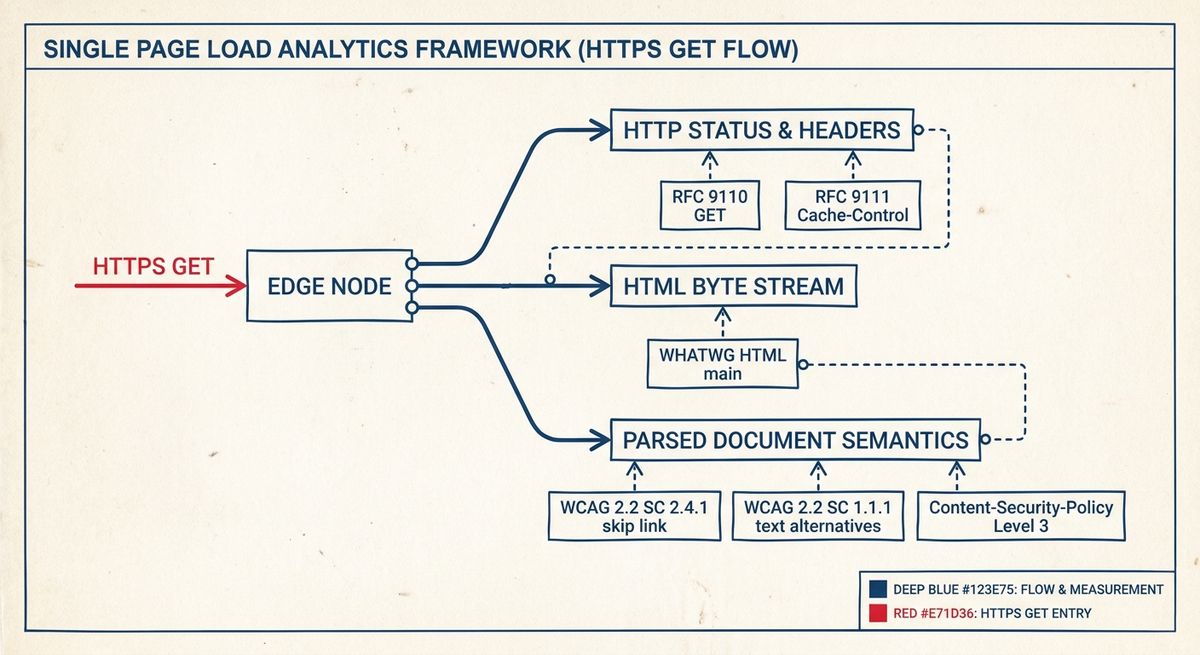
Overview
Our measurement for DTC ecommerce is: "DTC ecommerce (n=20 of 38 sampled, 47% refused an automated request, measured 2026-07-28): median server response 196 ms; median HTML 846 KB; skip link present on 55%; main landmark on 90%; median alt-text coverage 64%; median trackers 2; median third-party domains 16; consent mechanism on 65%". This is a wire-level result from one HTTPS GET per homepage with no JavaScript executed. The measurement therefore describes the server-delivered document and its immediately visible references, not the fully hydrated page after scripts, personalization, or late-loading components.
The problem this method solves is precise: it separates the base document contract from browser-side execution. A direct-to-consumer homepage can appear fast after cached script execution while still shipping a large first HTML representation, many third-party origins, or missing navigational affordances in the initial document. Conversely, it can have a fast median server response while still depending on client code for content that should be present in HTML. Wire measurement asks what a user agent, crawler, assistive technology, cache, or diagnostic probe can learn before JavaScript runs.
The refusal rate is part of the result, not noise. DTC ecommerce has "n=20 of 38 sampled, 47% refused an automated request, measured 2026-07-28". Retail chains have "n=17 of 35 sampled, 51% refused an automated request, measured 2026-07-29". Those high refusal rates mean neither row should be generalized as representative of its whole sector. They are still useful for systems analysis because refusal is itself a deployed behavior at the HTTP edge: the homepage contract is conditional on bot classification, TLS fingerprinting, headers, or request reputation.
How it works
At systems level, the test is deliberately narrow. A client opens an HTTPS connection, sends an HTTP GET for the homepage, follows the response enough to collect status, headers, body bytes, and embedded references, and does not execute JavaScript. The relevant protocol stack is TLS for transport security, HTTP Semantics in RFC 9110 for request method and response meaning, HTTP Caching in RFC 9111 for cache directives, HTTP/2 in RFC 9113 or HTTP/3 in RFC 9114 where negotiated, and URL processing as defined by the WHATWG URL Standard.
That design turns the homepage into a measurable representation. "Median HTML 846 KB" for DTC ecommerce, with "n=20 of 38 sampled, 47% refused an automated request, measured 2026-07-28", is not total page weight; it is the median size of the returned HTML representation in the accepted responses. "Median third-party domains 16" for the same DTC ecommerce sample is not a count of executed network requests; it is the number of distinct external origins discoverable from the base document. "Median trackers 2" is likewise a base-document signal, not a complete runtime audit.
The accessibility checks are also base-document checks. A skip link is detected as an in-page bypass mechanism, usually an anchor whose fragment target moves focus toward main content. A main landmark is detected through the HTML main element or equivalent ARIA role. Alt-text coverage is computed over image alternatives available in the delivered markup. In the DTC ecommerce row, "skip link present on 55%; main landmark on 90%; median alt-text coverage 64%" with "n=20 of 38 sampled, 47% refused an automated request, measured 2026-07-28" describes the pre-execution affordances that assistive technology can encounter without waiting for client-side rendering.
What the standard says
HTTP is clear about the baseline request. RFC 9110 defines GET as a method for transferring a current representation of the target resource and classifies it as safe; that does not guarantee acceptance. A server or intermediary may still return status codes such as 403 Forbidden under RFC 9110, while 429 Too Many Requests is defined by RFC 6585 and the RateLimit header fields remain an IETF Internet-Draft (draft-ietf-httpapi-ratelimit-headers) rather than a published standard. A refused automated request therefore belongs in the wire record because it changes the externally observable contract.
HTML and accessibility standards say more than many homepage implementations expose. The WHATWG HTML Living Standard defines the main element as content consisting of the dominant contents of the body. WAI-ARIA 1.2 defines the main landmark role for the primary content area. WCAG 2.2 Success Criterion 2.4.1, Bypass Blocks, requires a mechanism to bypass repeated blocks of content; a skip link is a common implementation, though the criterion does not require that exact pattern. WCAG 2.2 Success Criterion 1.1.1, Non-text Content, requires text alternatives for non-text content, with documented exceptions. HTML also requires the img alt attribute except in limited cases described by the specification.
There is no single W3C or WHATWG consent banner element. On the wire, consent is inferred from document-visible mechanisms such as consent dialogs, scripts, or state hooks, while the underlying browser primitives are separate: HTTP cookies are defined by RFC 6265, Set-Cookie response fields carry cookie state, and Web Storage is defined by the HTML Standard. The Global Privacy Control signal, Sec-GPC, is a W3C Community Group specification rather than a W3C Recommendation. This distinction matters: a "consent mechanism on 65%" for DTC ecommerce, with "n=20 of 38 sampled, 47% refused an automated request, measured 2026-07-28", is an observed UI or integration pattern, not conformance to a universal consent standard.
Trade-offs
The strongest DTC ecommerce result is server response. In the supplied cross-sector ordering, "Median server response ms: DTC ecommerce 196, Developer tools 255, AI platforms 282, Fintech 294, Retail chains 297, Healthcare 348, B2B SaaS 351 (best first)"; the relevant sample sizes are DTC ecommerce n=20 of 38, Developer tools n=33 of 35, AI platforms n=33 of 35, Fintech n=28 of 35, Retail chains n=17 of 35, Healthcare n=29 of 35, and B2B SaaS n=33 of 35. The engineering interpretation is that a fast origin or edge response can coexist with a heavy representation and a broad third-party surface.
That coexistence is visible in the DTC ecommerce row: "median server response 196 ms; median HTML 846 KB; median trackers 2; median third-party domains 16" with "n=20 of 38 sampled, 47% refused an automated request, measured 2026-07-28". The trade-off is not simply speed versus features. Large HTML can improve first paint if it contains meaningful content, but it also increases transfer, parse, memory, and cache invalidation cost. Many third-party origins can distribute responsibility for images, analytics, consent, fraud checks, or embedded widgets, but each distinct origin introduces DNS, connection, certificate, prioritization, and policy interactions.
The accessibility trade-off is different. DTC ecommerce is relatively strong on a main landmark but weaker on image alternatives: "skip link present on 55%; main landmark on 90%; median alt-text coverage 64%" with "n=20 of 38 sampled, 47% refused an automated request, measured 2026-07-28". A product-heavy homepage may contain many decorative, responsive, or promotional images. The standard distinction is semantic: decorative images should have empty alternatives, while informative images need meaningful text. A raw coverage figure cannot decide author intent, but it identifies where human review should begin.
Failure modes
The first failure mode is edge refusal that hides the homepage from non-browser agents. The supplied ordering says "Refused automated request %: B2B SaaS 6, AI platforms 6, Developer tools 6, Healthcare 17, Fintech 20, DTC ecommerce 47, Retail chains 51 (best first)"; the sample sizes are B2B SaaS n=33 of 35, AI platforms n=33 of 35, Developer tools n=33 of 35, Healthcare n=29 of 35, Fintech n=28 of 35, DTC ecommerce n=20 of 38, and Retail chains n=17 of 35. Diagnosis starts by recording status code, response headers, TLS protocol, HTTP version, redirect chain, and whether the refusal is deterministic across user-agent strings and accepted content types.
The second failure mode is semantic deferral: the initial HTML contains shell markup while the meaningful page arrives only after JavaScript. Wire diagnosis compares the parsed document against HTML expectations: is there one dominant main region, is the document title present, do primary links have accessible names, are img alternatives present, and do forms have associated labels? Browser APIs such as DOMParser, the Accessibility Object Model where available, PerformanceNavigationTiming, and Resource Timing can then be used in a separate executed run to determine what changed after hydration.
The third failure mode is uncontrolled third-party expansion. DTC ecommerce shows "median third-party domains 16" with "n=20 of 38 sampled, 47% refused an automated request, measured 2026-07-28". A base-document domain count does not prove harm, but it identifies policy boundaries. Diagnosis should map each origin to the initiating element, the applicable Content-Security-Policy directive, cookie attributes, referrer policy, and fetch destination. CSP is standardized through W3C Content Security Policy Level 3; Referrer-Policy is a W3C specification; Fetch defines request modes, credentials modes, and destination values that explain what the browser is allowed to send.
A minimal implementation
A correct minimal homepage implementation begins with an HTML document that is useful before scripts. It has a descriptive title, a skip link that targets the primary content, exactly one primary main landmark, headings in logical order, links and buttons with accessible names, and image alternatives chosen according to WCAG 2.2 Success Criterion 1.1.1. JavaScript may enhance interactions, but the base document should not depend on script execution to expose navigation, product categories, legal links, or consent controls.
At the HTTP layer, the minimal implementation returns a normal 200 representation for a safe GET unless there is a documented abuse condition. It sends correct Content-Type, cache validators such as ETag or Last-Modified where suitable, Cache-Control consistent with RFC 9111, compression negotiated through Accept-Encoding, and security headers such as Content-Security-Policy, Referrer-Policy, Strict-Transport-Security, and Permissions-Policy when their policies are intentionally configured. Third-party references should be explicit in the HTML, not injected unpredictably by chained scripts, so that the base document can be audited.
The measurable target is not to copy another sector’s row but to make each trade-off intentional. The DTC ecommerce measurement, "DTC ecommerce (n=20 of 38 sampled, 47% refused an automated request, measured 2026-07-28): median server response 196 ms; median HTML 846 KB; skip link present on 55%; main landmark on 90%; median alt-text coverage 64%; median trackers 2; median third-party domains 16; consent mechanism on 65%", shows why: fast response alone does not describe the homepage contract. A minimal implementation is the smallest standards-conformant document that remains navigable, understandable, cacheable, policy-bounded, and measurable before JavaScript runs.