B2B SaaS Homepages and Consent Mechanisms
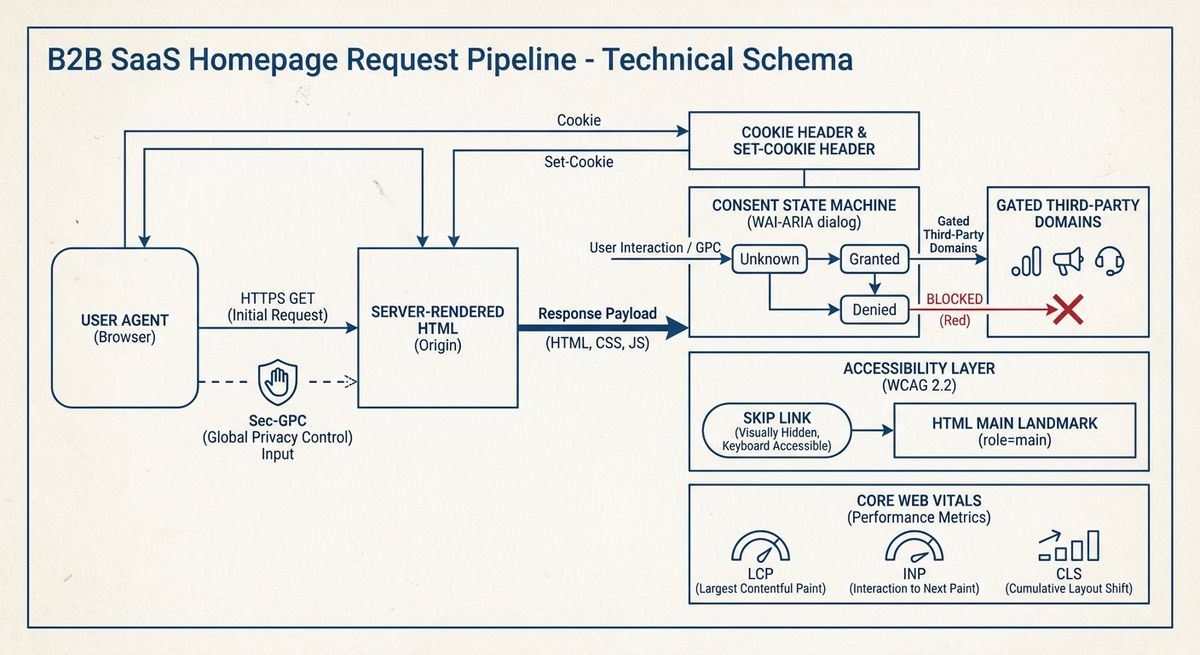
Overview
Our own measurement starts with the B2B software row: B2B SaaS (n=33 of 35 sampled, 6% refused an automated request, measured 2026-07-29): median server response 351 ms; median HTML 571 KB; skip link present on 45%; main landmark on 88%; median alt-text coverage 65%; median trackers 2; median third-party domains 12; consent mechanism on 67%. The measurement used one HTTPS GET per homepage with no JavaScript executed, so it describes the initial document and server-visible response, not runtime behaviour after hydration, geolocation, personalization, or interaction.
The precise problem solved by a B2B SaaS homepage consent mechanism is narrower than a banner suggests. It is a control plane for deciding whether non-essential storage, client identifiers, and third-party network requests may be activated before a visitor has made a choice. The homepage must also remain navigable and perceivable while that control plane is present. That is why the same row contains accessibility indicators: skip link present on 45%, main landmark on 88%, and median alt-text coverage 65% for B2B SaaS (n=33 of 35 sampled, measured 2026-07-29). Consent is not separable from document structure when the mechanism is rendered as blocking UI.
Adjacent software categories show the same architectural shape with different initial-document signals. Our own measurement recorded: AI platforms (n=33 of 35 sampled, 6% refused an automated request, measured 2026-07-29): median server response 282 ms; median HTML 395 KB; skip link present on 18%; main landmark on 82%; median alt-text coverage 79%; median trackers 1; median third-party domains 10; consent mechanism on 36%. Developer tools (n=33 of 35 sampled, 6% refused an automated request, measured 2026-07-29): median server response 255 ms; median HTML 408 KB; skip link present on 30%; main landmark on 85%; median alt-text coverage 78%; median trackers 1; median third-party domains 10; consent mechanism on 48%. These rows make B2B SaaS distinctive in this sample because it combines the highest consent-mechanism coverage with the largest software-category median HTML and server-response medians.
How it works
At systems level, a consent mechanism is usually a state machine spanning server HTML, client JavaScript, storage APIs, and request gating. The initial HTML may include a dialog, inline preference controls, or a placeholder. Until consent state is known, the page should avoid loading non-essential scripts, pixels, iframes, and SDKs. After a choice, the state is commonly represented in first-party storage and used to unblock tags or keep them suppressed. The important boundary is not visual display; it is whether the browser performs storage access or network requests that depend on the user choice.
The relevant browser mechanisms are ordinary web primitives: Set-Cookie and Cookie headers from RFC 6265, the HTML script element, fetch and XMLHttpRequest, Web Storage, the Cookie Store API where supported, and the Permissions Policy and Content Security Policy response headers when they are used to constrain capabilities and destinations. A server-side renderer can emit no third-party script until consent exists. A client-rendered application can do the same only if its bootstrap bundle does not itself load non-essential dependencies before the preference module runs.
The measurement is useful because it catches what is shipped in the first document. For B2B SaaS (n=33 of 35 sampled, measured 2026-07-29), median trackers 2 and median third-party domains 12 appeared alongside consent mechanism on 67%. That pairing indicates that consent UI and third-party dependency graphs frequently coexist in the initial delivery path. It does not prove that those trackers fired before consent, because no JavaScript was executed. It does, however, identify the pages where a runtime audit should inspect the Network, Application, and Storage panels before and after each consent choice.
What the standard says
There is no W3C or WHATWG specification named “cookie banner.” The underlying requirements come from several layers. The HTML Living Standard defines landmarks such as the main element and interactive controls such as button and dialog. WAI-ARIA 1.2 defines roles including main, dialog, and alertdialog when native semantics are insufficient. WCAG 2.2 is the current W3C accessibility recommendation; relevant success criteria include 1.1.1 Non-text Content, 2.1.1 Keyboard, 2.4.1 Bypass Blocks, 2.4.3 Focus Order, 2.4.7 Focus Visible, 2.4.11 Focus Not Obscured (Minimum), and 4.1.2 Name, Role, Value.
For consent itself, the EU framework is the most explicit public rule set commonly implemented in web architecture. GDPR Article 4(11) defines consent as freely given, specific, informed, and unambiguous. GDPR Article 7 requires that the controller be able to demonstrate consent and that withdrawal be as easy as giving consent. The ePrivacy Directive 2002/58/EC, Article 5(3), addresses storage of information or access to information already stored in terminal equipment, with an exception for what is strictly necessary. These provisions do not require a particular UI pattern; they require the system to distinguish necessary from non-necessary operations.
Current privacy signals also matter. The Global Privacy Control specification from the W3C Privacy Community Group defines the Sec-GPC HTTP request header and navigator.globalPrivacyControl JavaScript property. The specification describes a browser-level signal that a site can observe and map into its own preference logic. It is not a replacement for every consent requirement, but it is a concrete input that a correct mechanism can process before client-side activation. For performance terminology, the current Core Web Vitals are Largest Contentful Paint, Interaction to Next Paint, and Cumulative Layout Shift; Interaction to Next Paint replaced First Input Delay in 2024. The measured server response and HTML size are diagnostics, not Core Web Vitals.
Trade-offs
The B2B SaaS row shows the central trade-off: B2B SaaS (n=33 of 35 sampled, 6% refused an automated request, measured 2026-07-29): median server response 351 ms; median HTML 571 KB; median trackers 2; median third-party domains 12; consent mechanism on 67%. A higher presence of consent mechanisms is not automatically better if the mechanism is only decorative, blocks keyboard access, or loads the very code it claims to control. Conversely, fewer visible mechanisms are not automatically leaner if non-essential requests still occur silently.
The cross-sector orderings computed from the same rows put B2B SaaS in context without turning the sample into an industry census. Consent mechanism %: B2B SaaS 67, DTC ecommerce 65, Retail chains 59, Developer tools 48, Fintech 43, AI platforms 36, Healthcare 24 (best first). Median server response ms: DTC ecommerce 196, Developer tools 255, AI platforms 282, Fintech 294, Retail chains 297, Healthcare 348, B2B SaaS 351 (best first). For B2B SaaS (n=33 of 35 sampled, measured 2026-07-29), the combination is notable: the row leads consent-mechanism coverage among the measured categories but is last in the provided server-response ordering.
Other sectors are useful comparators but require caution. Our own measurement recorded: DTC ecommerce (n=20 of 38 sampled, 47% refused an automated request, measured 2026-07-28): median server response 196 ms; median HTML 846 KB; skip link present on 55%; main landmark on 90%; median alt-text coverage 64%; median trackers 2; median third-party domains 16; consent mechanism on 65%. Retail chains (n=17 of 35 sampled, 51% refused an automated request, measured 2026-07-29): median server response 297 ms; median HTML 833 KB; skip link present on 41%; main landmark on 71%; median alt-text coverage 93%; median trackers 1; median third-party domains 11; consent mechanism on 59%. Because those refusal rates were 47% and 51%, the measured rows are not representative of those industries; they are the subset that answered the automated HTTPS request.
Failure modes
The most common systems failure is pre-consent execution. It appears when the initial HTML or bootstrap bundle loads third-party scripts, iframes, or fetch destinations before a preference is read. Diagnosis requires two passes: a clean browser profile with storage cleared, and a second pass after each choice. Inspect Set-Cookie, Cookie, localStorage, sessionStorage, indexedDB, request initiators, and Content-Security-Policy reports. A homepage can display a consent mechanism on 67% of B2B SaaS pages in this sample (n=33 of 35 sampled, measured 2026-07-29) and still fail if the network graph is already active before the choice.
Accessibility failures are equally concrete. A consent dialog can trap focus permanently, omit an accessible name, hide the page without using inert or equivalent focus management, place decline behind a non-keyboard control, or obscure the skip link. In the B2B SaaS row (n=33 of 35 sampled, measured 2026-07-29), skip link present on 45%, main landmark on 88%, and median alt-text coverage 65% describe the surrounding document, not the consent UI itself. A diagnosis should therefore include keyboard-only traversal, accessible-name inspection, focus restoration after closing the dialog, and verification that the main landmark remains reachable.
The comparator rows show that a low-consent or low-tracker page is not automatically correct. Healthcare (n=29 of 35 sampled, 17% refused an automated request, measured 2026-07-28): median server response 348 ms; median HTML 153 KB; skip link present on 62%; main landmark on 69%; median alt-text coverage 89%; median trackers 0; median third-party domains 11; consent mechanism on 24%. Fintech (n=28 of 35 sampled, 20% refused an automated request, measured 2026-07-29): median server response 294 ms; median HTML 545 KB; skip link present on 21%; main landmark on 82%; median alt-text coverage 75%; median trackers 1; median third-party domains 10; consent mechanism on 43%. The diagnostic question is always whether the page’s actual storage and request behaviour matches its declared categories.
A minimal implementation
A correct minimal implementation starts server-side. Send semantic HTML with a skip link, a single main element, descriptive alt text for informative images, and no non-essential third-party script tags in the initial response. Include the consent UI as native HTML controls: buttons for accept, reject, and settings; a dialog only if focus is managed according to the HTML and WAI-ARIA models; and visible keyboard focus. If Sec-GPC is present, read it before emitting optional resources and ensure any response variation is compatible with HTTP caching semantics, including Vary where representation differs.
The preference model should be small and auditable: necessary operations are always on; optional categories default off until an affirmative choice; rejection is stored with the same durability as acceptance; and withdrawal uses the same reachable control path. Store only the minimum state needed, such as a first-party consent version and category booleans. For cookies, use Secure on HTTPS, SameSite=Lax unless a stricter or cross-site need is justified, and avoid using consent storage as a general identifier. The implementation should not require a third-party script to decide whether third-party scripts may run.
The minimal release test is mechanical. With an empty profile, load the homepage, record the initial requests, storage writes, landmarks, keyboard order, and accessible names. Choose reject, reload, and verify that optional destinations remain blocked. Choose accept, reload, and verify that only the accepted categories activate. Change the preference and confirm withdrawal. The B2B SaaS baseline measured here (n=33 of 35 sampled, measured 2026-07-29) gives concrete audit priorities: consent mechanism on 67%, median third-party domains 12, median trackers 2, skip link present on 45%, and main landmark on 88%.